

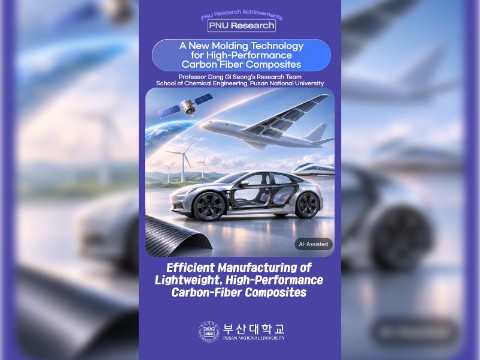
A research team led by Professor Dong Gi Seong at Pusan National University has developed a new manufacturing process that uses water-like, low-viscosity material to rapidly produce lightweight, high-performance carbon-fiber composites, with potential applications in aerospace and electric vehicles.
In conventional thermoplastic composite manufacturing, molten resin can be highly viscous, making it difficult to flow through carbon fibers uniformly. This can leave internal voids in the material, making it challenging to manufacture large composite structures quickly and consistently.
Instead of injecting molten plastic, the researchers developed a new process that first injects water-like, low-viscosity reactive materials through the carbon fibers, which are then converted into solid thermoplastic inside the mold.
By combining two types of nylon, the team developed a reactive resin system that can be injected at just 90 degrees Celsius. The resulting composites achieved a porosity of less than 1%, demonstrating outstanding molding quality.
Stronger bonding between the carbon fibers and the polymer matrix resulted in a 22.7% increase in interlaminar shear strength compared with existing PA6-based composites. Water absorption was also reduced to approximately one-third of the previous level, demonstrating improved water resistance.
This breakthrough demonstrates the potential for the mass production of recyclable, lightweight, high-performance composites. The technology could support future applications in advanced industries, including aerospace, electric vehicles, and hydrogen-powered mobility.
[Editor's note = This video was produced using InfoX, Yonhap Infomax's AI-based video content production system, and Yonhap has not edited the content in any way, nor does it reflect the editorial direction of Yonhap.]
Source: Pusan National University
◆ 한눈에 보기
· 발행 기관 : 부산대학교
· 배포 : 2026년 11월 11일 오후 3시 02분
출처 : 부산대학교 보도자료
· · · · · · · · · ·
한국사회복지저널은 AI 기술의 도움을 받아 보도자료와 복지 정보를 보다 쉽고 정확하게 전달하기 위해 노력하고 있습니다.
