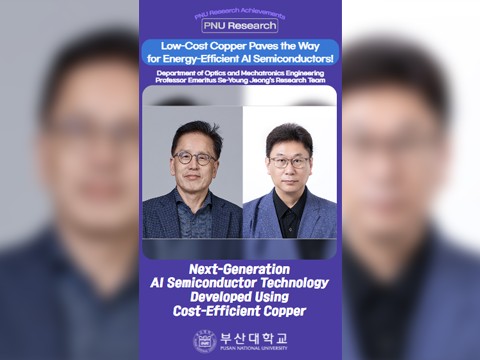
A research team led by Professor Se-Young Jeong at Pusan National University has developed a key technology for next-generation energy-efficient AI semiconductors by replacing an expensive platinum with more cost-efficient copper.
The technology forms a thin oxide layer on the surface of copper, enabling the efficient conversion of electrical current into signals that control magnetization.
The research team precisely oxidized the copper foil, creating a highly uniform and well-defined interface between copper and copper oxide.
As a result, the core capability for electrically controlling magnetization was enhanced by approximately tenfold compared with naturally oxidized copper.
The efficiency of magnetic control reached a level comparable to that of platinum, a commonly used but more expensive material. At the same time, the researchers achieved higher spin-torque conductivity, reaching a world-leading level in this key performance metric.
By replacing expensive metals with copper, the researchers were able to address the long-standing challenges of high power consumption and heat generation. These achievements are expected to pave the way for more energy-efficient AI semiconductors and next-generation memory devices.
[Editor's note = This video was produced using InfoX, Yonhap Infomax's AI-based video content production system, and Yonhap has not edited the content in any way, nor does it reflect the editorial direction of Yonhap.]
Source: Pusan National University
◆ 한눈에 보기
· 발행 기관 : 부산대학교
· 배포 : 2026년 10월 22일 오후 1시 36분
출처 : 부산대학교 보도자료
· · · · · · · · · ·
한국사회복지저널은 AI 기술의 도움을 받아 보도자료와 복지 정보를 보다 쉽고 정확하게 전달하기 위해 노력하고 있습니다.